

Welcome back readers.
Lots of good stuff to share this week–21 reads in all. A critical blackjack? No, no, not my best work. To support our best work–compiling and organizing a living timeline of critical games writing every week–please consider our Patreon. Patreon support has no bearing on the amount of awful puns and jokes I make, and less bearing still on their hit rate.
This Week in Videogame Blogging is a roundup highlighting the most important critical writing on games from the past seven days.
Extended Play
We’ll start things off this week with some notes on industry and culture.
- Celebrate Juneteenth by Supporting These Brilliant Black Game Developers | PCMag
Jordan Minor highlights Black developers, stories, and advocacy in the games inudstry. - What’s Not Yours Isn’t Theirs, Either | Date ’em Ups
Thomas James breaks down, in granular and unambiguous detail, why using an LLM to translate Segagaga sucks (and many reasons why you should care) (Further Reading: Brian Merchant’s talks with translators impacted by the LLM boom). - Gamers Can Be Sports Fans Too, Y’all, It’s Okay | But Why Tho?
Kate Sánchez lambasts the nerd-jock binary for the weird fake thing that it is (Further Reading: Robert Yang’s Sportslike Manifesto). - notes from the underground | \\………..//
Liz Ryerson made an album.
“i said 13 years ago on this blog that pop music was what i really wanted to try and pursue, not videogames. it can be painful to read back over stuff from that era for me. a lot has changed in the world since then, and i certainly have a different understanding of myself now than i used to. but has that feeling ever really changed for me? not really. i mean, it’s kind of been a funny joke to me to be some videogames person when in my head i should have had some kind of music career: if having a music career wasn’t an equally, if not even more embarrassing, thing to have at this point. i think i’m mostly okay with my current state of being now, maybe not financially. but my point is that music never was some kind of dalliance or side thing for me even if i was never able to really put it together in a way that didn’t feel compromised.”
SCART Cables
These next four picks focus on older games, examining a few mysteries along the way.
- Bio Force Ape | Retro XP
Madeline Blondeau assembles a fragmentary history of perhaps the NES’ most notorious vaporware title (Further Reading: Kate Willaert on Stuntman). - Wild Gunman (Nintendo, 1974) | exp.
Mathew Kumar prods at a video mystery behind one of Nintendo’s oldest coin-op games. - The CRPG Addict: Game 579: Multi-User Dungeon (1978)
Chester Bolingbroke plays the very first MUD (Further Reading: Aaron A. Reed on MUD1). - Omega Boost: Peak PlayStation | Kimimi The Game-Eating She-Monster
Kimimi splits the difference on what is if nothing else the most Polyphonic of all mecha games (Further Reading: Kimimi’s previous writing on Vixen 357).
“Omega Boost is a symbol of PlayStation’s ’90s success… and excess. It does things no other console at the time could, and frequently makes expensive choices just because it can. It’s a fantastic way to show off the system’s technical strengths. But as a game it has little to offer that isn’t definitively outdone by a large number of similar titles—many of them created for older, weaker hardware—I’ve already mentioned.”
Forward-Thinking
These next few situate their games in the context of their developers, legacies, and popular reputations.
- Bubsy 4D – The Bobcat Chases Golden Fleece | startmenu
Luis Aguasvivas finds in the new Bubsy an antitode to decades of low-hanging Youtube meme game fodder (Further Reading: wasnotwhynot on the original Bubsy). - Barbarian – “Thanks big boy” | Super Chart Island
Iain Mew surveys the always-ill-defined goalposts for obscenity in one microcomputer publisher’s efforts to chase those goalposts down for profit. - Metal Gear Solid 4 Is An Important Disaster Of A Game | Kotaku
Harper Jay MacIntyre divines the metatextual reasoning behind MGS4‘s nightmarish bricolage (Further Reading: Lilly on Metal Gear Rising).
“This game is a creator’s panic attack, a multi-hour-long reckoning with the intersection of money and art where the enemies we face are mostly Frankenstein-monster creatures assembled out of the leftover bits of the franchise. Of any game ever made, Guns of the Patriots is perhaps the clearest, most evocative exploration of what happens when a franchise goes on longer than planned.”
Homework
Two picks on learning and teaching games and play.
- Games for the Game Studies Classroom | Gamers with Glasses
GwG compiles a list of free, accessible games for the prospective game studies teacher to consider putting on their syllabus (Further Reading: Ashley P. Jones on designing and teaching a feminist gaming class). - A Learning Experience – Star Ocean: First Departure R | Pixpen
Sam Howitt ponders the right ratios of challenge and guide support in playing an RPG that didn’t quite click (Further Reading: Katherine Castle on Tunic).
“Recently I’ve thought more about the practical purposes that manuals can serve. It’s useful to have a document in which game information is contained, especially for a lengthy game like an RPG. I’m not one to complain too much about tutorials, as much as they can grate a little on replays, but I’ve really started to like the idea of figuring out a videogame. A little purpose-built reference book can be a great distraction-free way of doing so.”
Design and Designer
Two picks on design decisions and decisive designers.
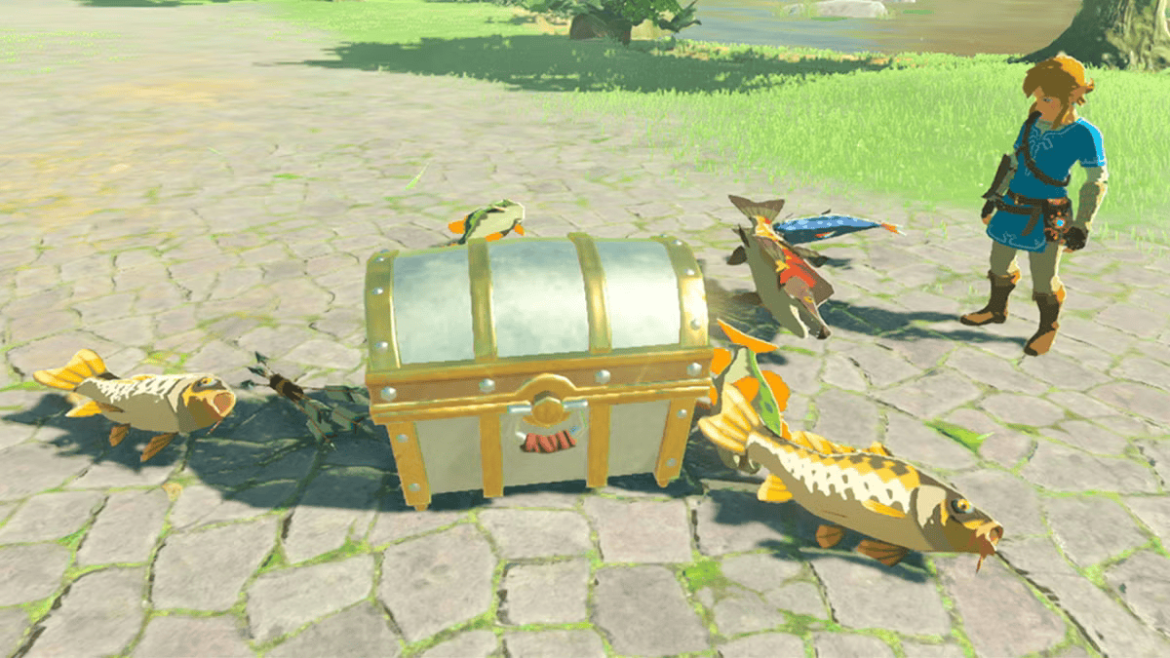
- weapon durability (shoes) | one more run
Grayson Morley runs his runners into the ground to illustrate a point about Breath of the Wild (Further Reading: Skeleton on Death Stranding). - You Can’t Just Do That: Talking About Subject-Tone Dissonance With Roksim | Adult Analysis Anthology
Hunter M unpacks the irreverent ethos and oeuvre of non-con artist/dev Roksim.
“When I play Roksim’s games, I feel like I’m being handed a new way of looking at something. Too often am I, as an artist, paralyzed by my own sense of taste. Too often am I, as a dominant woman, paralyzed by my sense of responsibility. Too often am I, as an autistic transgender woman, paralyzed by worrying about how I’m perceived. The Lizzy games are a reassurance that this sort of art can work! Some people might not see the significance, but Roksim’s works have been truly inspiring to me. A non-zero degree of influence on my efforts to become a creepier, more off-putting person, which has genuinely only had positive effects on my social and artistic pursuits!”
Spect-Actors
This next section brings together sustained critical inquiries and reflections across a spread of topics: anticolonialism, family history, and theatre.
- The Player’s the Thing | Willa Writes
Willa Rowe draws on Brecht and Boal to critique Titanium Court‘s understanding of revolutionary theatre (Further Reading: Nicanor Gordon on the play in play). - I Am Looking For My Father In Blue Prince’s Spiral Of Stars | Kotaku
Rebekah Valentine delves into one family history, room-by-room, seeking answers to another (Further Reading: Luca Fisher on 1000xRESIST). - Echoes of Fanon in XCOM 2 | Skybox
J.M. Henson studies the theory and practice of anticolonial revolt as allegorized in XCOM 2.
“XCOM 2 stages itself to create sympathy for revolutionary bodies in the real world, and to challenge the player to question the narratives of terrorism and violent resistance against conquering bodies. It provides an accessible angle to understand the label of “terrorist” as a strictly political term, rather than an academic one. An old adage suggests that one man’s terrorist is another man’s freedom fighter, and XCOM 2 allows the player to inhabit the duality of this role. If attacking armed authorities who are free to inflict violence upon civilians is terrorism, what does that make the gunning down of the innocent to maintain state control? Suggesting the two are equivalent only masks the moral rot of the latter, and robs the former of context and cause.”
Tomodachi Living
Two interesting reads this week on Tomodachi Life: Living the Dream.
- Meet the People Resurrecting Their Loved Ones in Tomodachi Life | This Week in Videogames
Maddie Agne talks to players remembering their lost loved ones by making Miis of them in Tomodachi Life (Further Reading: Rae Maybee on the original Tomodachi Life). - Tomodachi Life is helping me check in on myself | Mothership
Latonya “Penn” Pennington relearns the routines of self-care with Tomodachi Life.
“I started to play Tomodachi Life as a way to clear my headspace early in the morning before starting my day. As I checked in on my Mii and the others, I would give them food, clothing, hobbies, and relationships to raise their happiness level. It was then I started to ask what my real self needed and wanted to be happy and healthy.”
Critical Chaser
Sorry : )
- He Can Fart To Fly Around, Too – Fuck’s Quest II Review | Gamesline
John Michonski plays one of the games of all time.
“I initially wanted to say “if you can look past these things, there’s a well put-together game here”, but no. You need to think this brainrot is hilarious or don’t bother. I can only recommend this to people who love YouTube Poop and similar things. This is a consistently rewarding game for people who know what a Dinner Blaster is. I’m kinda surprised it’s not in this game, to be frank.”
Subscribe
Critical Distance is community-supported. Our readers support us from as little as one dollar a month. Would you consider joining them?
Contribute
Have you read, seen, heard or otherwise experienced something new that made you think about games differently? Send it in!