

Welcome back readers.
I’m quite sunburnt from attending local pride festivities in my town. I’d say it was worth it, and that’s true, but please wear sunscreen anyway. Check out our Patreon if you want to buy me sunscreen (Curator’s Note: Chris is paid a fixed honorarium for their curation work and will not be renumerated with an additional sunscreen stipend over and above that if you choose to help support the Critical Distance project!).
This Week in Videogame Blogging is a roundup highlighting the most important critical writing on games from the past seven days.
In Play
You’ll have to bear with me this week; I don’t have ironclad certainty in how I’ve sorted this week’s picks into sections, and some of the divisions are rather messy. Nonetheless, I hope I can offer some interesting combinations. Let’s start with three up top unpacking games along material, artistic, and ontological axes.
- Which Gaming Hardware Companies May Have Funded Armed Conflict In 2025? | Kotaku
Rebekah Valentine investigates how firm of a handle major hardware providers have on their supply chains in an annual review (Further Reading: Brendan Sinclair’s previous edition of this review). - Stop Talking About Games This Way | Patreon
Dorian Dawes contemplates nostalgia, constraints, the tools of the artist, and the medium’s parallel obsession with and insecurity about “retro” (Further Reading: Ana Bahia on the enduring importance of Flash games). - We are All NPCs Now: Making Sense of The Amazing Digital Circus | Unwinnable
Shira Chess unpacks the next generation’s wary understanding that the ludic century is somebody else’s game (Further Reading: Liz Ryerson on the political outcomes of gamergate).
“Ultimately, The Amazing Digital Circus demonstrates that if the 2010s were a galvanization of gamers and an increase of societal gamification, then the 2020s seem to be the moment where we lost the thread, a mutation from being active, agentic players into becoming passive non-player characters.”
Wavelengths
Ecocritical inquiries, theories, and themes guide our next set.
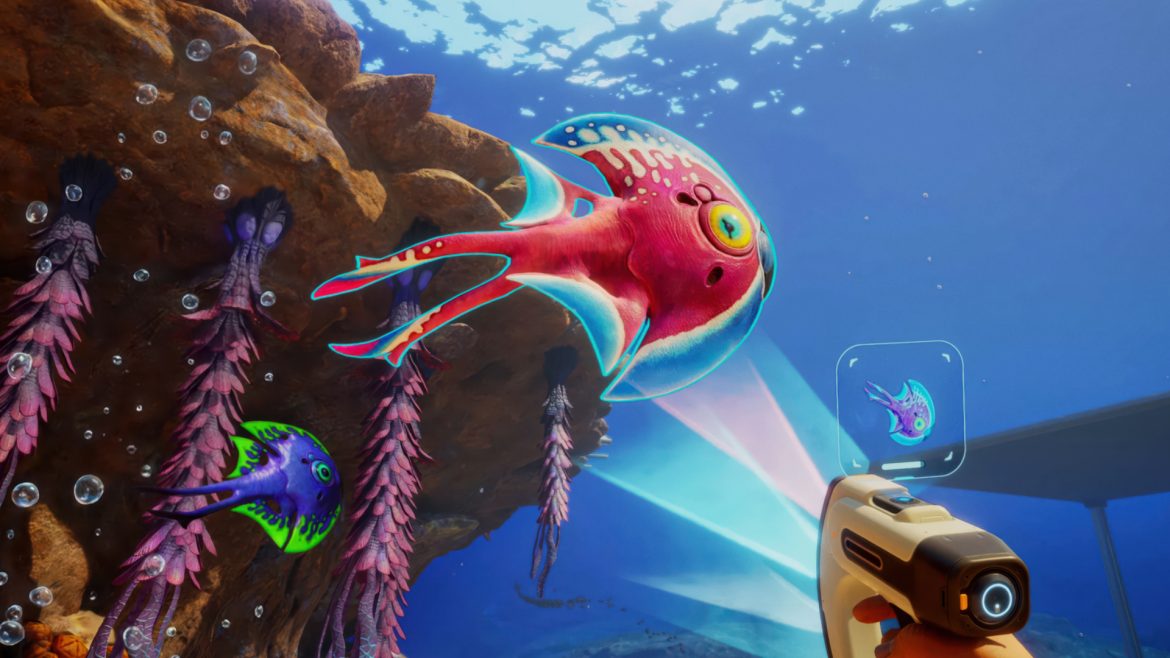
- Swim in the Wreckage: Subnautica 2 Early Access | Remap
Bruno Dias finds that so far Subnautica 2 rises to its ecocritical moment (Further Reading: Edwin Evans-Thirlwell on Subnautica 2). - Paranormacrisis | Unwinnable
Phoenix Simms contemplates how climate change shapes our storytelling via the lens of a New Weird horror VN (Further Reading: Pao Yumol on Marathon and the New Weird).
“Each of the characters in The Seven Mysteries of Honjo have a personal crisis that gets enfolded in the malaise of Honjo’s permacrisis. Everyone, including the player, must look back and forth constantly between the suffering of the past and how it translates into the present. The camera work of the game and its interactive timeline makes you perform hypervigilance as you seek a way to muddle through the murkiness of permacrisis. The only way you progress in Paranormasight is by understanding that you only have your perspective and the way to find more stability is by helping people share their unique perspectives and perceptions of the permacrisis with each other.”
Rising Action
I think Jay’s piece below would have fit just as happily in the previous group, but I’m making this next one about design.
- Do Porn Games Need Choices? | Adult Analysis Anthology
Braden Liatris describes the taxonomy and signifance of choice-based structures in porn games (Further Reading: Emily Short on storylets). - Built Broken | Unwinnable
Jay Castello prods the contradictions that result from Terra Nil‘s framing of ecological restoration around the city-builder format (Further Reading: Ruth Cassidy on human presence in Terra Nil).
“Humanity can only be imagined as a destructive force unless its touch is brief and directed. But this falls apart as you fly away, condemning the planet you’re leaving behind to homogenise once again. But at least you have your photographs to prove that you once aligned things exactly to plan.”
Gods and Devils
Another loose one, variously bringing together ideas about ideology, religion, and capital.
- LET ME RUN AND I WON’T HIDE | DEEP-HELL
Guilherme Alves Galvão questions whether capital truly subsumes Marathon‘s critique (Further Reading: Charlotte Lindsay on Marathon). - The bad vibes of Shin Megami Tensei | scrmbl
Adam Wescott situates the original SMT in its time and place (Further Reading: Kimimi on SMT‘s Mega CD port). - The Virtue of Uncertainty: Faith and Resistance in Final Fantasy X | Unwinnable
Gavin Craig contemplates religion and its contradictions of corruption and community in Spira and beyond (Further Reading: Yussef Cole on Elden Ring‘s cosmology and theology).
“I am far more interested, in art as in life, in those who seek to redeem faith in their life and practice from the hypocrisy of the worst of its leaders, and the presentation of religion in Final Fantasy X is interesting far less for its portrayal of the corruption of the exertion of organized power than in its insistent recognition that religion, faith, ritual, and practice can also be sources of power in community and resistance.”
Heat Action
This one’s straightforward enough: two on Yakuza.
- Yakuza Needs to Let Players Scrap with Women, Too | SUPERJUMP
Hiero de Lima awaits a woman in the Yakuza series who is allowed to take a punch with the best (and worst) of them (Dia Lacina on Yakuza: Like A Dragon). - Like a Hero(ine) | Stop Caring
Niki Fakhoori compares the literary structures of Yakuza 0 and Like A Dragon to understand why Ichi’s journey hits different (Further Reading: Chingy Nea on Ichiban Kasuga).
“Even if the games aren’t always perfect about how they write women and other marginalized characters, when considered all together, the gradual self-improvement is evident. And that is precisely the message the Heroine’s Journey would have its audiences remember: people are made of many facets. Their traits are stronger when integrated together. In the same way, while self-sufficiency is its own kind of strength, people are always stronger together.”
Lesser of Nine Evils
A bad good game and a good bad game.
- Requiem for a Nightmare: The Dissonance of Resident Evil 9 | Unwinnable
Emma Kostopolus finds that a Resident of all Evils is a master of none (Further Reading: Grace Benfell on RE Requiem). - Fighters Megamix: Beautifully broken | Kimimi The Game-Eating She-Monster
Kimimi plays the most Sega Saturn fighting game of all time (Further Reading: Jennifer Allen on Eternal Champions).
“So no, this isn’t a good fighting game by any traditional measure. It’s packed with weird, unworkable ideas that don’t gel together particularly well, if at all. New moves, characters, and features break the game in myriad ways. It’s a fighting game built for living rooms alone, a non-competitive mush of random stuff for a maximum of two people to muck about with, no fairness or balance included or implied. And I love it.”
Critical Chaser
I’m partial to the Shadow Star, myself.
- Checkpoints #1 – Kirby Air Riders, Applied Physics, and You | Deleted Saves
Drew Byrd muses on how Sakurai et al. designed a new Kirby racer for sickos without leaving behind everyone else (Further Reading: Aaron Lascano on Kirby Air Ride).
“As Sakurai learned with Super Smash Bros. Melee, when a system deepens, so too does the competitively-minded player’s desire to invest time and effort to master it, and he appears to have tailored Air Riders to reflect this inevitability. The deployment of sophisticated new physics alongside the exponential heightening of the skill ceiling indicate a new willingness on Sakurai’s part to embrace contemporary expectations around online gaming, but those innovations aren’t simply there for the sake of the ladder climbers: they exist to enrich the overall experience, to put super-speedy hamster-smashing joy in the hands of any gamer so inclined.”
Subscribe
Critical Distance is community-supported. Our readers support us from as little as one dollar a month. Would you consider joining them?
Contribute
Have you read, seen, heard or otherwise experienced something new that made you think about games differently? Send it in!